
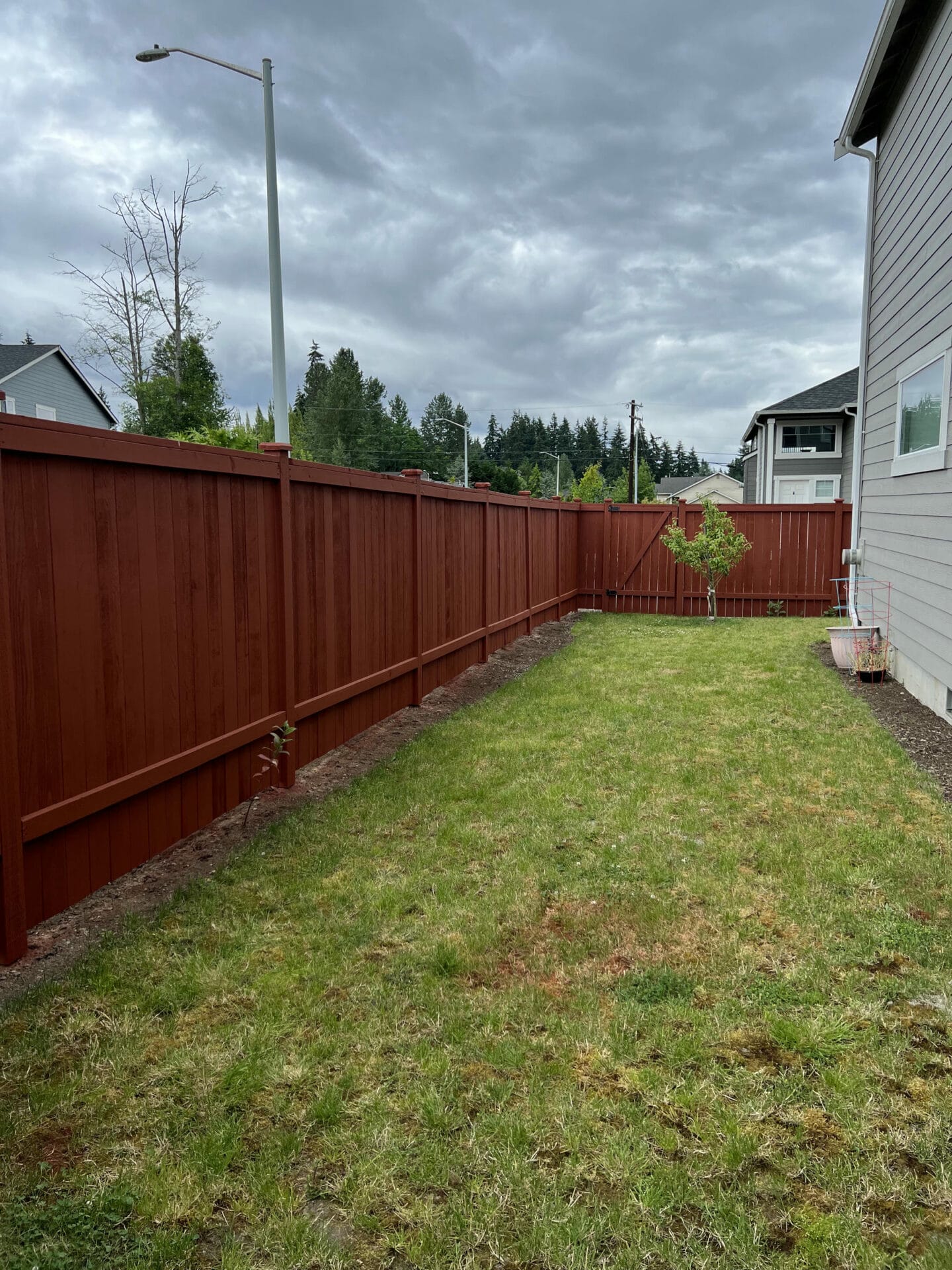
Every fence and deck in King and Snohomish County eventually reaches a crossroads. The wood grays, the finish wears thin, and a homeowner has to decide whether a fresh coat of stain will bring the structure back to life or whether it is time to tear it out and start over. Getting this call wrong in either direction costs money. Replace a structure too early and you throw away years of useful life. Wait too long and small problems turn into safety hazards. This guide walks through the framework professionals use to make that call, why our wet Pacific Northwest climate speeds up wood breakdown, and what to expect if a full rebuild turns out to be the right move.
How to Tell If Your Fence or Deck Needs Staining or Replacing
The biggest mistake homeowners make is judging a structure by its color alone. A faded, silvery gray fence or deck looks tired, but graying is a surface level reaction to sunlight breaking down the wood’s outer fibers. It does not mean the boards underneath have lost their strength. If the framing is solid, with no soft spots, deep cracks, or rot, staining is almost always the more cost effective and protective choice.
The Water Bead Test
A quick way to check whether a deck or fence still needs stain is to sprinkle a little water on the surface. If it beads up and sits on top of the wood, the existing finish is still doing its job. If the water soaks in within a minute or two, the protective barrier has broken down and moisture is free to work its way into the grain, which is a good sign it is time for a professional re-stain.
Signs You Just Need a Fresh Stain
A structure is usually a good candidate for cleaning and staining rather than replacement when the wood is graying or fading, when surface cracks are shallow rather than deep, when the texture is rough or splintery but a light sanding smooths it out, when mildew or algae lifts away with a proper wash, and when the wood still feels solid and firm everywhere you press or probe it.
Signs You’re Looking at a Replacement
Replacement becomes the safer option when boards feel soft or spongy under a screwdriver, when cupping or warping is severe enough to create a trip hazard, when nails or screws keep popping loose as the wood swells and shrinks, when you can see insect tunnels or termite damage, or when a fence leans, sags, or wobbles under moderate pressure, which usually means the posts have rotted at the base. Rust that has eaten deep into metal posts, brackets, or fasteners is another sign that the hardware has lost its load bearing capacity.
The 25 Percent Rule
Contractors use a simple benchmark to decide between repair and replacement. If more than about a quarter of the structure shows heavy rot or damage, full replacement is usually the smarter investment, since patching a structure that far gone tends to trigger repeat repairs that add up to more than a rebuild would have cost in the first place. Below that threshold, a combo approach often makes the most sense. Replace the small percentage of boards that are actually compromised, then clean, sand, and stain the entire structure so it looks and performs like new. This stretches the life of sound lumber without the expense of a full teardown.
Why Pacific Northwest Weather Is So Hard on Outdoor Wood
Western Washington’s marine climate is uniquely tough on unprotected wood. Sunlight breaks down the lignin that holds wood fibers together, which is what causes the surface to gray and shed whatever color was applied before. At the same time, our long rainy season keeps wood fibers swelling and shrinking over and over, and that constant movement is what eventually shows up as cracking, splitting, and warping. Add in the mild, damp conditions that mildew and wood decay fungi love, and it is easy to see why a deck or fence in Bothell or Everett can age faster than the same structure would in a drier climate. We cover how this same moisture and temperature swing affects exterior finishes in Understanding Exterior Paint Drying Times in the Pacific Northwest, and much of that same logic applies directly to stained wood surfaces.
Modern Stains Do More With Less
Stain technology has changed a lot over the last decade. Traditional oil based stains once set the standard for penetration and durability, but tightening air quality regulations have pushed the industry toward advanced water based formulas. Many of today’s water based stains use nano scale particles that reflect UV rays and resist moisture, and independent testing shows some of these newer products outperforming older oil based stains by a wide margin while meeting stricter environmental standards. For homeowners, that means a properly applied modern stain job protects longer and fades more slowly than the products used even five or ten years ago. Our wood staining team stays current on which products perform best in our climate, so request a free estimate if you would like a recommendation for your specific fence or deck.
If Replacement Is the Right Call
When damage is widespread enough to cross that 25 percent threshold, replacement becomes the responsible option. Staining only protects sound wood. It cannot restore structural integrity to boards that have already failed. Total project cost depends heavily on which material you choose for the new structure.
Comparing Decking and Fencing Materials
Pressure treated wood costs the least upfront but needs re-staining every two to three years, which adds up over the life of the structure. Cedar and redwood resist rot naturally and look beautiful, but still need periodic sealing to prevent graying and checking. Composite and PVC decking cost more initially but need little beyond occasional cleaning, which can make them less expensive over a fifteen to twenty year span. Dense hardwoods like ipe last the longest of all, often forty years or more, at a higher upfront cost. Whichever material you choose, the substructure underneath deserves just as much attention as the visible boards.
Why the Framing Underneath Matters
A lot of deck problems trace back to the framing rather than the decking itself. Standard pressure treated lumber arrives at the job site still full of moisture from the treatment process, and it continues to shrink and twist for months after installation. If a rigid composite or hardwood surface is fastened to that green lumber, the movement underneath can telegraph through to the surface as ripples, gaps, or fasteners working loose. Kiln dried after treatment lumber, often called KDAT, solves this by removing most of that excess moisture before the wood ever leaves the mill, so the framing stays flat and stable and can be sealed or stained immediately instead of waiting the better part of a year for it to dry out on its own.
Hardware and Corrosion Protection
Our damp climate also makes fastener choice more important than many homeowners realize. Copper based preservatives in modern treated lumber react with plain steel, so decks and fences here need hot dip galvanized or coated fasteners at minimum, and stainless steel hardware for anything close to salt water. The ledger board, which is the piece that anchors an attached deck to the house, deserves particular attention. Most serious deck failures start there, so a rebuild should use proper lag screws or through bolts and structural tension ties rather than relying on nails alone.
Permits and Local Requirements
Most jurisdictions in King and Snohomish County require a permit once a deck exceeds a certain height above grade or a certain footprint, and permits are almost always required if the deck attaches to the house. Requirements vary by city, so it is worth a call to your local building department before work begins. If you are planning a project anywhere in King County or Snohomish County, our team can point you toward the right resources as part of your estimate.
Getting a Professional Opinion
The line between a stainable deck and one that needs replacing is not always obvious from the driveway, so it is worth having a professional take a look before committing to either path. Our team inspects the wood, checks the framing, and gives you a straightforward recommendation, along with a free estimate for whichever route makes the most sense. We also handle exterior painting for the rest of your home, so if your fence or deck refresh is part of a larger outdoor project, we can help there too. Get in touch and we will help you figure out the right next step for your fence or deck.