
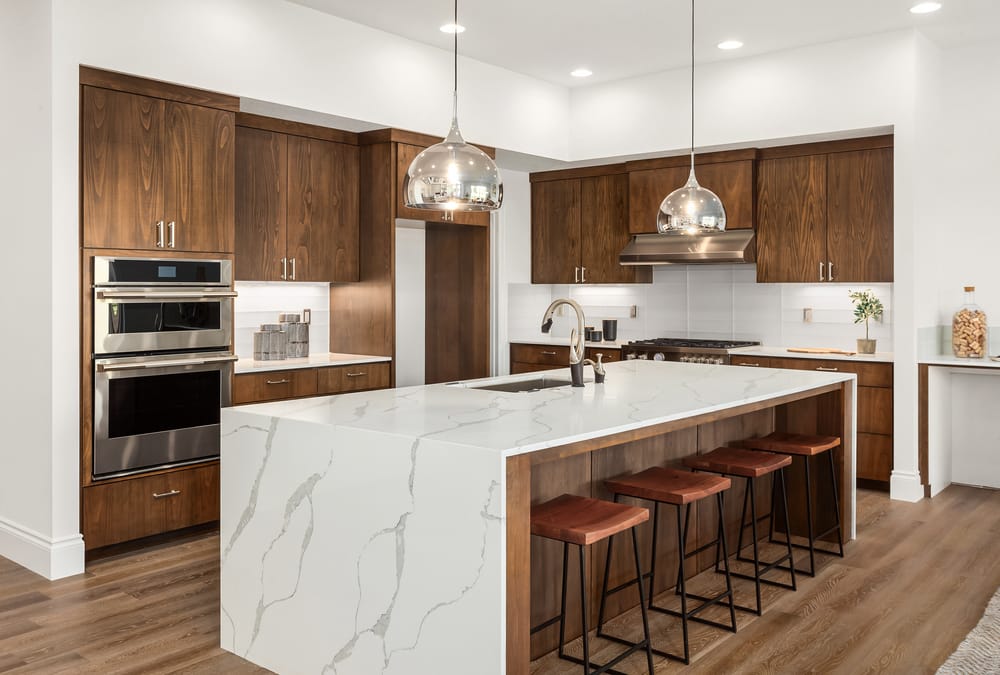
If you have stood in your kitchen wondering whether to repaint the cabinets or tear them out entirely, you are asking the right question at the right time. In 2026, that decision carries more weight than it used to. Seattle’s combination of high labor rates, a fresh round of tariffs on imported cabinetry, a bigger sales tax bill, and steeper disposal fees has changed the math on almost every kitchen project in King County.
This guide walks through what refinishing, refacing, and full replacement actually cost in the Seattle area right now, what determines which option makes sense for your kitchen, and where the hidden expenses tend to show up. If your cabinet boxes are solid and you just want a fresh, durable finish, our cabinet painting services cover exactly that. If you are still deciding which route fits your kitchen, keep reading.
Why 2026 Changed the Numbers
A few things happened at once this year that make cabinet decisions more expensive across the board.
Seattle homeowners who locked in a mortgage under 4 percent before 2022 are staying put rather than buying at today’s rates, where a comparable million-dollar home now runs monthly payments north of $5,000 instead of roughly $1,900. That has pushed more people to renovate in place and pull from home equity to do it, which means more kitchens are getting a second look this year than in a typical cycle.
At the same time, the cost of doing that work went up. Skilled carpentry and trade labor in the Seattle area now runs $65 to $95 an hour, a 40 to 60 percent premium over national rates. Tariffs on Chinese-manufactured cabinetry that took effect in late 2025 added 10 to 14 percent to the cost of imported ready-to-assemble and stock cabinets. Seattle’s combined sales tax climbed to 10.55 percent as of January 1, 2026, and that tax applies to labor as well as materials on a remodel. On top of that, the Seattle Department of Construction and Inspections raised construction permit fees by 18 percent this year, and King County’s Solid Waste Division now charges $243.38 per ton for self-haulers dropping off demolition debris.
All of that pushes the math toward methods that keep your existing cabinet boxes in place. That is a meaningful part of why refinishing and refacing have become the more popular path for Seattle kitchens this year, and it is worth understanding the real numbers behind each option before you decide.
Start With the Boxes, Not the Doors
Before you can choose a direction, you need an honest look at what your cabinets are made of, because that answer decides whether refinishing and refacing are even on the table.
A lot of Seattle homes built in the 1970s and 1980s have cabinet boxes made from entry-level particleboard. Particleboard does not tolerate the Pacific Northwest’s humidity well. Steam from the dishwasher, a slow plumbing leak, or just years of ambient moisture causes it to swell and delaminate. If you press on the bottom of a cabinet or near the sink base and feel soft spots or see warping, that box will not hold new hinges reliably no matter what you put on the doors. At that point, replacement is the only real option.
Cabinets built with solid plywood boxes are a different story. Plywood’s cross-laminated construction resists warping and holds screws and hinges far better over time, which is why a well-built 20 or 30 year old kitchen with plywood boxes is often a stronger foundation than a brand-new set of entry-level stock cabinets sold today. If your boxes are plywood and structurally sound, refinishing or refacing is usually the smarter move.
Door material matters too, and it works a little differently than most homeowners expect. Solid wood looks great, but five-piece Shaker doors made from solid wood naturally expand and contract with humidity, and that movement eventually cracks any paint film running along the joinery. It is a normal result of wood movement, not a sign of bad workmanship. For a painted finish that holds up long-term in this climate, factory-built MDF doors are actually the more stable choice, since MDF has no grain direction and does not move the way solid wood does.
Cabinet Refinishing: What It Costs and Why Prep Is Everything
Refinishing means restoring or repainting the cabinets you already have, in the same layout, using the same doors and boxes. It is the lowest-cost option by a wide margin because it sidesteps the countertop, flooring, and plumbing work that comes with tearing anything out.
For a standard 20 to 30 linear foot Seattle kitchen in 2026, professional refinishing runs $1,500 to $5,500, with most homeowners landing between $3,100 and $3,500.
| Pricing Metric | Low End | High End | Typical |
|---|---|---|---|
| Per door/drawer, gel stain | $80 | $140 | $110 |
| Per door/drawer, sand and paint | $100 | $175 | $135 |
| Per door/drawer, conversion varnish | $175 | $250 | $215 |
| Per square foot | $4 | $25 | $10 |
| Total project, standard kitchen | $1,500 | $5,500 | $3,100 |
Labor is the biggest line item here. Local contractors charge $55 to $75 an hour, and on a typical job about 65 percent of the budget goes to labor, 20 percent to coatings and primers, and the remaining 15 percent to prep supplies and site masking.
That prep step is the part homeowners tend to underestimate, and it is the single biggest factor in whether a refinished cabinet lasts five years or fifteen. Industry data puts the failure rate for coating jobs at roughly 80 percent traceable back to inadequate surface prep, not the paint itself. Kitchen cabinets build up a film of cooking grease and residue that has to be fully broken down before anything sprayed or brushed on top will actually bond. A rushed wipe-down is not enough. Reputable Seattle refinishers use a degreasing pass, mechanical sanding to create a surface the primer can grip, and, on heavily grained woods like oak, a stain-blocking primer to prevent tannins from bleeding through as yellow blotches later. Skip any of those steps and you get peeling and fish-eye defects within a year, regardless of how good the paint was.
On the coating side, standard wall paint has no place on cabinetry. Most residential jobs use premium 1K waterborne urethane-acrylics, which are durable, dry fast, and do not require mixing a catalyst. Higher-traffic kitchens sometimes call for 2K polyurethanes or conversion varnishes, which cure through a chemical reaction rather than evaporation and hold up to nearly anything you put on a counter, but they require specialized spray equipment and a controlled environment, so most contractors pull the doors off-site to a spray booth for that step.
Reputable Seattle refinishing companies back their work with 5 to 10 year warranties covering peeling or adhesion failure from prep or material defects. What those warranties will not cover is normal wear: dents from pots and pans, harsh cleaners, or hairline cracks at the joints of solid wood Shaker doors, which happen because the wood itself is moving, not because the coating failed.
Cabinet Refacing: The Middle Option With the Best Return
Refacing keeps your existing cabinet boxes exactly where they are but replaces the doors, drawer fronts, and hardware, then wraps the visible face frames and end panels in a matching veneer or laminate. It looks like a full new kitchen without the demolition.
The appeal in Seattle right now comes down to cost and disruption. Refacing typically runs 40 to 60 percent less than full replacement, and because it does not touch the countertop or trigger the domino effect of collateral repairs that replacement does, a standard kitchen refacing project runs $4,000 to $14,000, averaging around $8,500.
| Material | Cost per Linear Foot | Typical Total (30 ft, Installed) |
|---|---|---|
| Laminate / rigid thermofoil | $70 – $125 | $4,500 – $6,500 |
| Wood veneer (oak, cherry, maple) | $140 – $250 | $6,000 – $9,500 |
| Solid wood, premium hardwoods | $200 – $500 | $10,000 – $15,000+ |
Timeline is where refacing really separates itself. A full gut renovation typically takes a kitchen out of service for 6 to 16 weeks. A refacing project is usually done in 3 to 5 business days, which matters a lot if you are trying to avoid weeks of takeout and a kitchen full of dust.
Refacing is also the natural time to upgrade hardware you have been living with for twenty years. Swapping old hinges for 35mm European soft-close hinges, or side-mounted drawer slides for undermount soft-close glides, costs $700 to $1,400 for a typical ten-drawer kitchen once installation is included, but it changes how the kitchen feels every single day. That upgrade is a common add-on to refinishing projects too, not just refacing.
Full Replacement: When the Boxes Have to Go
If the existing boxes are compromised, the layout is genuinely inefficient, or you are after an open-concept redesign, replacement is the option that actually solves the problem. It is also, by a wide margin, the most expensive.
| Cabinet Tier | Cost per Linear Foot (Installed) | Typical Kitchen Total | Lead Time |
|---|---|---|---|
| Stock / RTA | $80 – $300 | $3,200 – $8,000 | 1 – 3 weeks |
| Semi-custom | $150 – $650 | $8,000 – $25,000 | 4 – 8 weeks |
| Full custom | $500 – $1,200+ | $20,000 – $50,000+ | 8 – 16 weeks |
Stock and RTA cabinets look like the budget-friendly choice, but the math shifted this year. The 10 to 14 percent tariff on Chinese-manufactured components hit that tier the hardest, and a lot of RTA lines still rely on particleboard boxes that will not hold up long in a damp climate anyway.
Semi-custom is where most Seattle homeowners land if they are replacing cabinets outright. Sourcing regionally from manufacturers like Bellmont Cabinet Co. in Sumner or Canyon Creek Cabinet Company in Monroe avoids the tariff and shipping delays entirely, and both build with plywood boxes and KCMA-certified finishes designed to hold up to Pacific Northwest humidity. Canyon Creek also still offers traditional framed construction, which matters if you own a Craftsman or Tudor home in a neighborhood like Wallingford or Capitol Hill and want a period-appropriate look rather than a frameless European profile.
The number that catches people off guard is what happens after the cabinets come out. Removing base cabinets makes it impossible to save the countertop above them, and a new quartz countertop runs $55 to $120 per square foot installed, typically adding $2,500 to $10,000. Tearing that out usually damages the backsplash too, adding another $800 to $4,500. Flooring that was installed up to the edge of the old cabinets gets exposed once the footprint changes, which can mean $2,000 to $7,000 in flooring repair. If your remodel involves switching to an induction cooktop, upgrading an older electrical panel to handle the load can add $4,000 to $9,000 on its own. It is not unusual for a project that started as “replace $15,000 of cabinets” to become a $40,000 to $80,000 kitchen remodel once all of that is factored in.
The Rules That Add to Your Budget
A few Seattle-specific and Washington-specific costs apply no matter which path you choose, and they are easy to miss when you are comparing quotes.
Cosmetic work, including refinishing, refacing, and like-for-like replacement in the same footprint, does not require an SDCI permit. That is a real advantage for those two paths. Full replacement that involves structural changes, moving plumbing, or upgrading an electrical panel does require a permit, and SDCI’s 2026 fee increase pushed its base plan review rate to $292 an hour. Simple projects can move through in a few days under the Subject to Field Inspection track, but anything involving a structural change, such as removing a wall for an open kitchen, goes through full plan review, which can take 4 to 14 weeks given Seattle’s seismic zone requirements.
Washington’s destination-based sales tax means the rate that applies is set by your home’s location, and construction labor is taxed the same as materials. At Seattle’s current 10.55 percent combined rate, a $60,000 remodel carries more than $6,300 in sales tax alone, a number that a lot of national cost calculators leave out entirely.
Disposal costs also deserve a line in your budget if you are replacing cabinets. King County’s self-haul rate is now $243.38 per ton, and if your home was built before 1980 and the old cabinets or flooring test positive for asbestos or lead, disposal runs even higher through specialized handling. One way to offset that cost is deconstruction instead of demolition: donating intact cabinets to an organization like Second Use or the Habitat for Humanity ReStore avoids tipping fees and can generate a tax-deductible receipt based on fair market value.
What Actually Pays You Back at Resale
If return on investment matters to your decision, the 2025/2026 JLC Cost vs. Value data for Seattle tells a pretty clear story, and it is not the one most homeowners expect.
| Project Scope | Average Seattle Cost | Value Added at Resale | ROI |
|---|---|---|---|
| Minor midrange remodel | $32,271 | $38,098 | 118.1% |
| Major midrange remodel | $95,542 | $50,700 | 53.1% |
| Major upscale remodel | $188,401 | $72,900 | 38.7% |
A minor midrange remodel, meaning refaced or refinished cabinet boxes, updated hardware, a mid-tier quartz counter, and fresh paint, actually returns more than it costs. Buyers in this market are prioritizing move-in-ready homes over fixer-uppers right now. Zillow’s 2026 analysis found that homes marketed as turnkey sell for a 2.9 percent premium, while homes needing work take a 14 percent hit at closing. A kitchen that already looks finished removes the biggest objection a buyer has, without the cost of over-improving the space.
That said, the right scope still depends on your neighborhood. In value-oriented areas like Burien, Tukwila, and Renton, keeping costs controlled with refacing and stock materials returns the most. In tech-driven markets like Bellevue, Kirkland, and Redmond, buyers expect a more modern, semi-custom look and will pay for it. In ultra-luxury pockets like Mercer Island and Medina, skimping on the kitchen actually works against you, since buyers in that price range expect custom cabinetry as a baseline, not an upgrade.
Which Option Is Right for Your Kitchen
If your cabinet boxes are solid plywood, the layout works for your family, and you mainly want a clean, modern, durable finish without the cost or disruption of a full remodel, refinishing is usually the best dollar-for-dollar choice. That is the service we focus on: our cabinet painting process uses the same commercial-grade prep and coating standards described above, built specifically for kitchens and bathrooms across Bellevue, Bothell, Everett, Lynnwood, Snohomish, and the rest of the greater Seattle area.
If you want the look of new cabinetry without touching the boxes, refacing is worth pricing out alongside refinishing, especially if your current doors are dated but the layout still works.
Full replacement makes sense when the boxes themselves have failed, when you are reconfiguring the kitchen, or when the cabinets are simply beyond saving. Just budget for the collateral costs, not only the cabinets, before you commit to that path.
Whatever direction fits your kitchen, get a real, in-person estimate before you decide. A quick photo or a phone quote cannot tell you what your cabinet boxes are actually made of, and that one detail changes the entire budget. If refinishing turns out to be the right fit, reach out for a free estimate and we will walk you through exactly what your kitchen needs.