
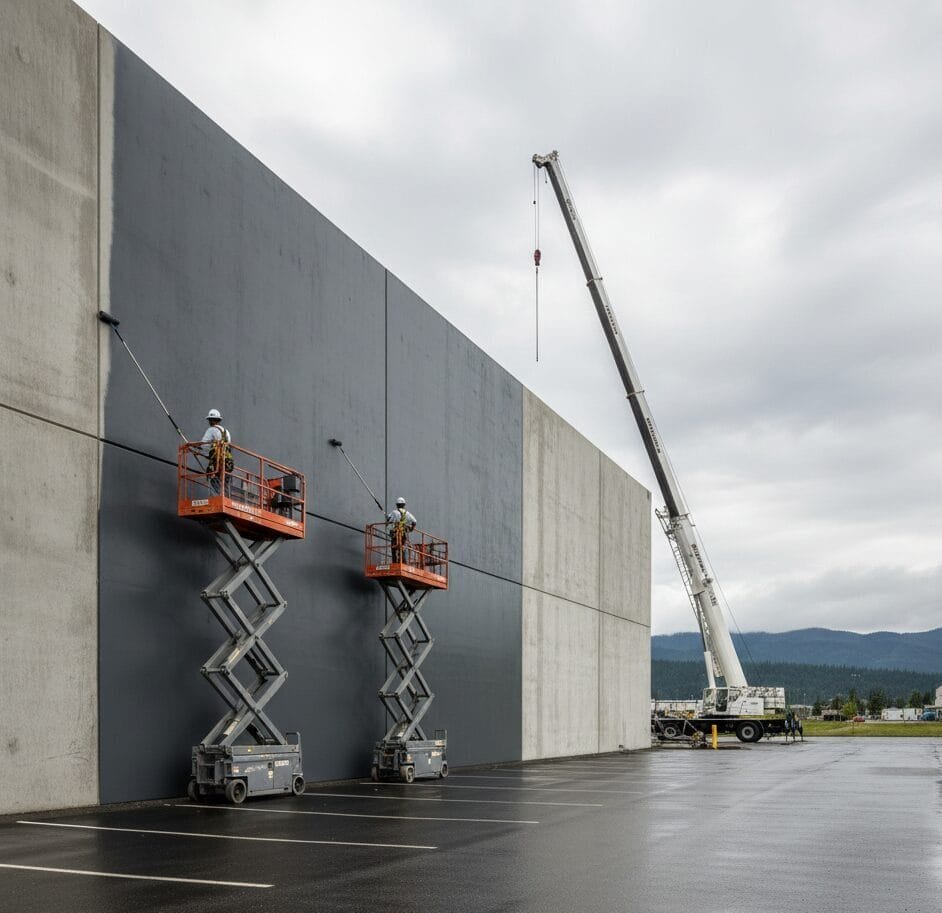
If you own or manage a commercial building in Seattle, painting is not a cosmetic line item. It is the first layer of protection between your building and a climate that stays wet most of the year. Get the timing and the scope right and a coating system lasts years longer than it should. Get it wrong and you end up paying for rotted trim, spalled concrete, and a repaint you already did.
This guide walks through what commercial painting in Seattle actually costs in 2026, what drives the number up or down, and which local rules quietly add money to a project. If you want to skip ahead, you can see our full range of commercial painting services or request a walkthrough and a written estimate.
What commercial painting costs in Seattle in 2026
Commercial painting is priced by paintable square footage, which is almost never the same as your leasable or gross square footage. Paintable surface is calculated wall by wall, height times width, minus windows and doors, with extra added back for textured or three dimensional surfaces. That is why two 10,000 square foot buildings can get very different bids.
Here is the range most Seattle area commercial projects land in, sorted by paintable surface:
| Paintable surface | Typical total cost | What is usually involved |
|---|---|---|
| 1,500 sq ft | $3,000 to $7,200 | Simple interior layouts, single story exterior, minimal prep |
| 2,000 sq ft | $4,000 to $12,000 | Retail interiors, small exterior facades, standard acrylics |
| 2,500 sq ft | $5,000 to $15,000 | Office suites, partial exterior repaints, occupied spaces |
| 3,000 to 5,000 sq ft | $6,000 to $30,000 | Light industrial, small warehouses, basic access equipment |
| 10,000 sq ft | $20,000 to $60,000 | Multi story offices, boom lifts, extensive prep |
| 20,000+ sq ft | $30,000 to $120,000+ | High rise access, logistics planning, high durability epoxy |
Broken down by scope, interior commercial work generally runs $1.50 to $4.00 per square foot as a baseline. Walls only in a standard office space averages around $3.50 per square foot. Add ceilings and you are closer to $4.50. A full detail package with walls, ceilings, millwork, doors, and trim typically runs $7.50 to $10.00 per square foot of paintable surface.
Exterior work costs more, usually $2.00 to $6.00 per square foot, with about $5.00 per square foot being a fair planning number for a full multi coat job. The gap comes from prep, weather resistant sealants, and access equipment. Specialty systems like elastomeric waterproofing, anti rust coatings on structural steel, or high build epoxy floors start above $6.00 per square foot and climb from there depending on film thickness.
What actually drives your number
Surface prep and hidden repairs
In the Puget Sound region, prep is the budget. Constant rain, marine humidity, and short drying windows mean exterior substrates take a beating. Standard prep includes pressure washing to remove moss and mildew, scraping failed coatings, caulking open joints, patching, and priming. What that prep uncovers is where budgets move.
Wood rot is the most common find on fascia, trim, window and door frames, and siding. Once moisture gets past the coating, decay moves fast because exterior wood here rarely gets a long dry stretch. Soft or spongy wood, bubbling paint, dark staining, and a musty smell are the early signs. Doing it right means cutting back to sound material, treating what is salvageable with epoxy consolidants and wood hardeners, and replacing the rest. New siding and trim should be primed and sealed on all sides before it goes up.
Concrete has its own version of this. Tilt up warehouses, parking structures, walkways, and patios take on water, which expands during freeze and thaw cycles and causes cracking and surface spalling. Restoring those surfaces means grinding or shot blasting off the weak top layer, repairing with cementitious overlays or epoxy and polyurethane injection, and only then applying stains, slip resistant finishes, or resinous floor coatings. If you have a tilt up or distribution building, our tilt up building painting page covers how we approach those substrates.
Coating selection
Material quality maps directly to how long the job lasts. Standard commercial acrylics run $25 to $60 per gallon and cover roughly 250 to 400 square feet, though that drops sharply on porous surfaces like aging cedar, split face block, or dry stucco. Elastomeric coatings, which bridge hairline cracks in concrete, cost $40 to $80 per gallon and only cover 75 to 300 square feet because they go on thick. Industrial epoxies and specialty urethanes run $50 to $150 per gallon with coverage between 80 and 350 square feet.
If you want a deeper look at what makes a commercial coating last, we wrote about the factors that impact the lifespan of commercial building paint jobs.
Access equipment
Anything above roughly fifteen feet needs scaffolding, a swing stage, or a boom lift. That equipment carries a daily burn rate of $500 to $1,500 or more, and it keeps running whether crews are working or not. This is the single biggest reason rain delays hurt a commercial budget. Every idle day is still a rental day.
Labor and scheduling
Hiring a commercial painter in the Seattle market generally runs $60 to $100 per hour as a burdened rate, which includes workers compensation, payroll taxes, insurance, and overhead. Washington construction trades sit well above the national average, and licensed, bonded, and insured crews land at the higher end of that range.
Production speed matters just as much as the rate. Brush and roller work covers about 150 to 200 square feet per hour on smooth, open interior walls, and much less when crews are working around occupied offices, fixed retail displays, or detailed millwork. Airless and HVLP spray systems cover far more ground on warehouse walls, exposed deck ceilings, and open siding, but they require much more masking and they waste more material to overspray. The right choice depends on how open the space is.
One thing to plan for: if you need work done after hours, on evenings, or on weekends to protect tenant operations or retail revenue, expect shift differentials and overtime to add as much as 50 percent to the labor portion of the budget. That is often worth it, but it should be a decision you make on purpose rather than a surprise on the invoice.
Seattle specific rules that affect your budget
Air quality and VOC limits
Commercial coatings in this region fall under the Puget Sound Clean Air Agency, which regulates volatile organic compounds and hazardous air pollutants. Practically, this means product selection is restricted, records have to be kept on what was applied, and industrial maintenance coatings on steel, tanks, and heavy wear concrete face tighter limits than standard architectural paint.
Low VOC and zero VOC products have gotten much better, but they cure differently. In damp Pacific Northwest conditions, waterborne acrylics and epoxies need a specific temperature and humidity window for the water to evaporate and the coating to bond properly. Applied outside that window, you get surfactant leaching or peeling. That chemistry is a schedule issue as much as a materials issue, and a longer schedule means more equipment rental days.
Heavy prep work like abrasive blasting often requires full containment with tarps or shrink wrap and negative air pressure with industrial dust collectors. Building, running, and taking down that containment is a real line item that rarely shows up in a simple per square foot estimate.
Street use permits
If your project needs scaffolding, a swing stage, a boom lift, or a material container in the public right of way, you are in Seattle Department of Transportation permitting territory. SDOT charges a base permit fee, hourly rates for staff review and inspection of traffic control plans, and an ongoing use fee based on how much street you occupy, for how long, and where. Downtown and dense urban centers carry higher multipliers than outlying areas, and blocking an arterial, a transit lane, a bike lane, or a sidewalk raises the number further.
The takeaway for budgeting is simple. On an urban core building, speed is money. Every extra day a crew occupies the sidewalk or the street compounds the fee. Pedestrian canopies, engineered traffic control plans, and city inspection hours all belong in the budget alongside paint and labor.
Historic districts
If your building sits in a designated historic district such as Pioneer Square, plan on a Certificate of Approval from the preservation board before any visible exterior change. The rules are specific. Unfinished brick, stone, and concrete masonry cannot be painted or sealed with opaque coatings. Paint is generally limited to wood window sashes, ornamental sheet metal, and historic wood or cast iron storefronts, and the colors have to stay within a subdued, historically compatible palette.
Repair is preferred over replacement, and anything that does get replaced has to match the original in design, color, texture, profile, and material. Signage and awnings usually get reviewed at the same time, with limits on projecting signs, lettering height, and awning materials. Budget for a longer approval timeline and specialized labor. A refresh that takes four weeks on a conventional suburban building can take months of planning and cost substantially more inside a preservation district.
Buildings built before 1978
Any sanding or demolition on a pre 1978 building has to follow EPA Lead Safe Certified Renovation, Repair, and Painting containment rules. That means controlled dust, contained work areas, and certified crews. It is not optional and it should be priced into the bid rather than discovered mid project.
What deferring the work actually costs
The most expensive version of a commercial paint job is the one you put off. Here is roughly how the math plays out on a standard 2,000 square foot commercial asset:
| Maintenance approach | What it involves | Financial impact |
|---|---|---|
| Proactive | Annual inspection, spot caulking, minor touch ups | Low, predictable operating expense that preserves the existing coating |
| Scheduled repainting | Full exterior repaint every 5 to 7 years, wash and minor patching | $11,000 to $18,000 |
| Deferred | Wood rot repair, trim and fascia replacement, concrete crack injection | $1,000 to $10,000+ in added structural repair |
| Failure | Siding replacement, mold remediation, wall rebuilds, full repaint | $15,000 to $25,000+ for substrate work, plus $1,500 to $10,000 for mold, plus paint |
A five to seven year exterior repaint cycle is the practical target for most commercial buildings in the Seattle area. Annual inspections between cycles catch failed caulking and early rot while they are still cheap to fix.
When to schedule commercial painting in Seattle
Timing is one of the few levers that saves money without cutting quality.
- Spring is the best window for rot assessments. Winter rain exposes the vulnerable spots, and fast curing epoxy repairs have time to set before the summer schedule fills up.
- Summer is the premium window for exterior work. Longer days and less rain give heavy elastomeric and epoxy systems the curing time they need.
- Fall is the last practical window for preventative work like sealing sills and patching trim before winter moisture takes over.
- Winter is best spent on interiors, where you control temperature and humidity.
The scheduling mistake we see most often is calling in July for August work. Good commercial crews book out through the summer, so late requests mean surge pricing or a slide into the wet fall months, which brings weather delays, containment costs, and a real risk of coating failure. Issuing your request for proposal in late winter or early spring gets you better pricing and a spot on the summer schedule. Our post on the best time to paint an exterior in the Pacific Northwest goes deeper on the weather windows.
How to compare commercial painting bids
A single per square foot price hides too much. Ask every bidder to break the proposal into separate line items for access equipment, surface preparation and repairs, coating materials, and application labor. When those are separated, you can see who is actually planning to prep and who is planning to paint over problems.
Questions worth asking before you sign:
- Have you painted buildings of this size and type before, and can I see them?
- Are you licensed, bonded, and insured, and can I get current certificates?
- Do you run background checks and drug testing on your crews?
- Exactly what prep is included, and how many coats are you quoting?
- Who is responsible for pulling permits and keeping VOC and product documentation?
- What happens to the schedule and the cost if it rains?
Build in a contingency of 15 to 20 percent above the hard bid. Hidden substrate damage is not fully knowable until the old coating comes off and the building gets washed, and right of way fees move with the actual schedule. A contingency turns a surprise into a planned expense.
If you are vetting contractors more broadly, our guide to finding a licensed and insured painting company in Seattle walks through the verification steps.
Frequently asked questions
How much does commercial painting cost per square foot in Seattle?
Interior commercial work generally runs $1.50 to $4.00 per square foot for a standard scope, rising to $7.50 to $10.00 per square foot when walls, ceilings, trim, doors, and millwork are all included. Exterior work runs $2.00 to $6.00 per square foot, with about $5.00 being a reasonable planning figure. Specialty coatings start above $6.00.
How often should a commercial building be repainted?
Most commercial exteriors in the Seattle area are on a five to seven year repaint cycle, with annual inspections and spot caulking in between. Buildings with heavy sun exposure, older wood siding, or deferred maintenance may need attention sooner.
Do I need a permit to paint my commercial building?
You do not need a permit to apply paint, but you do need a Seattle Department of Transportation street use permit if scaffolding, lifts, or containers occupy the public right of way. Buildings in historic districts also need a Certificate of Approval from the preservation board before any visible exterior change.
Can you paint while our business stays open?
Yes. Most commercial projects are phased so tenants and customers can keep operating, and a lot of the work happens in evenings or on weekends. Off hours scheduling adds to labor cost but it usually costs far less than lost revenue or disrupted tenants.
Get a real number for your building
Every range on this page is a planning tool, not a quote. The only way to budget a commercial repaint accurately is to have someone walk the building, measure the paintable surface, check the substrate for rot and spalling, and price the access and permitting the site actually requires.
Legacy Painting handles commercial work throughout Seattle and the wider King County area, including commercial painting in Bellevue and commercial painting in Lynnwood. We work on office buildings, retail spaces, warehouses, tilt up structures, schools, churches, and medical facilities. If you manage apartments or condos, our multi family painting services cover that side of the portfolio.
You can look through our commercial painting project photos to see recent work, then contact us for a free on site estimate.