
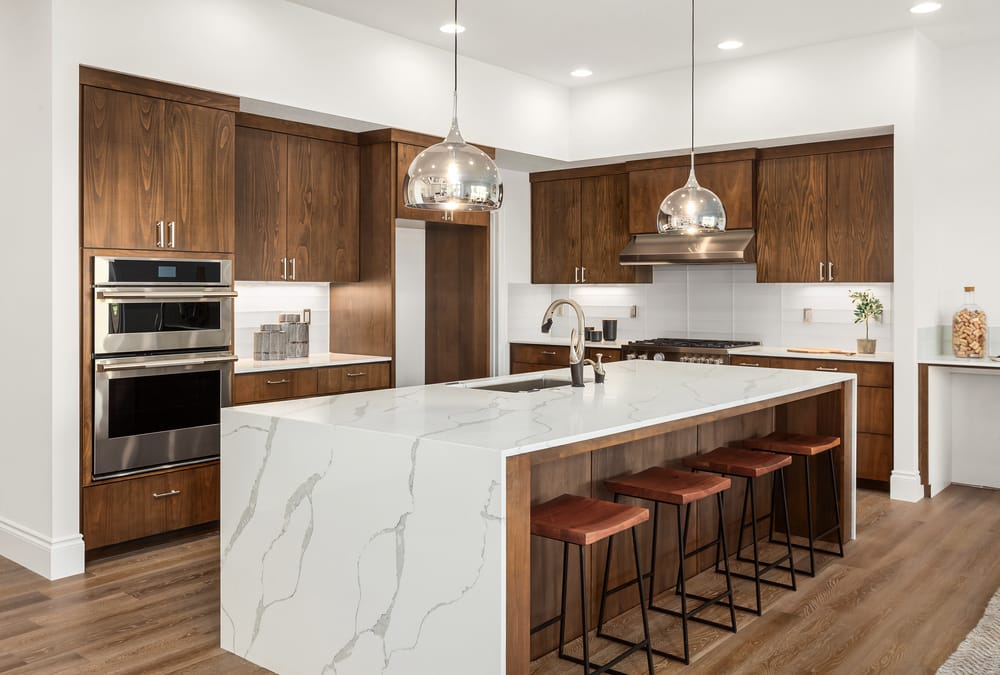
The cost to paint kitchen cabinets in the Seattle area comes down to three things: how many doors and drawer fronts you have, how much prep they need, and the finish you choose. If your cabinets are solid but tired, painting keeps the boxes and doors you already have, which is why cabinet painting services cost a fraction of new cabinets.
What It Costs to Paint Kitchen Cabinets in 2026
A standard 20 to 30 linear foot kitchen in the Seattle area costs $1,500 to $5,500 to refinish or paint professionally, with most homeowners landing between $3,100 and $3,500. Painters price by the piece, so the number of doors and drawer fronts, the prep they need, and the finish you choose move the total more than the size of the room.
Those figures are the average cost to paint kitchen cabinets when a professional crew does the work. More doors and drawer fronts cost more, whatever the square footage. Heavily grained wood, damaged surfaces, or a dark-to-light color change push the total higher.
How Painters Price a Cabinet Job
Most painters price cabinet work per door and drawer front, then add those unit costs into a whole-kitchen total. Knowing the cost to paint kitchen cabinets per door is the clearest way to compare quotes line by line. It also explains the cost to have kitchen cabinets painted better than any square-foot estimate.
What Gets Counted
Every door, every drawer front, every cabinet box and face frame, exposed end panels, and extras like crown molding or an island adds to the piece count. A kitchen that looks modest from the outside can carry a high piece count once every drawer front is tallied.
Per-Door Prices by Finish
| Pricing Metric | Low End | High End | Typical |
|---|---|---|---|
| Per door/drawer, gel stain | $80 | $140 | $110 |
| Per door/drawer, sand and paint | $100 | $175 | $135 |
| Per door/drawer, conversion varnish | $175 | $250 | $215 |
| Per square foot | $4 | $25 | $10 |
| Total project, standard kitchen | $1,500 | $5,500 | $3,100 |
On a typical job, about 65 percent of the budget goes to labor, 20 percent to coatings and primers, and the remaining 15 percent to prep supplies and site masking.
What an Itemized Quote Should List
A professional cabinet painting cost estimate should list doors, drawer fronts, boxes, end panels, and any extras as separate line items with unit prices. Only an in-person visit gives an accurate piece count, because a photo or phone quote cannot see what the boxes are made of or how much prep the surfaces need. Every free on-site estimate for our cabinet painting work ends in an itemized quote and a project schedule.
What Changes the Price of Painting Your Cabinets
Six factors move the price of a cabinet job, and they explain why two kitchens of similar size can get very different quotes.
Prep and Degreasing
Thorough prep pushes the price up, and skipping it causes early failure. Kitchen cabinets build up a film of cooking grease that has to be fully broken down before any primer or coating will bond. A rushed wipe-down is not enough.
A proper prep sequence starts with a degreasing pass and mechanical sanding, so the primer has a surface to grip. On heavily grained woods like oak, a stain-blocking primer stops tannins from bleeding through as yellow stains later. Industry data puts roughly 80 percent of coating failures down to inadequate surface prep, not the coating itself.
Repairs and Cabinet Condition
Chips, swollen edges near the sink and dishwasher, and loose joints all require attention before paint goes on. Repairs add time and material to the project scope. If the existing finish is failing and needs to be stripped first, that step is part of the prep process and is priced accordingly.
Changing the Color
Going from dark wood to white increases the cost because extra primer and coats are required. Oak tannins bleed through without a stain-blocking primer, and covering a deep brown or espresso finish with a light color takes more material and more passes than a like-for-like color refresh. That is what drives the cost to paint kitchen cabinets white when the starting point is dark wood.
Door Style and Material
Detailed or raised-panel doors take longer to coat than flat slab doors because every profile edge requires attention. Five-piece solid wood Shaker doors also move with humidity, and that movement eventually cracks any paint film running along the joinery. MDF doors hold a sprayed finish more consistently because MDF has no grain direction and does not expand and contract the way solid wood does.
The Finish and How It Is Applied
Sprayed finishes produce a smooth, even surface without brush marks and take more setup than brushing. Cabinets need cabinet-grade coatings rather than wall paint, and Sherwin-Williams and Benjamin Moore both make coatings built for surfaces that get handled every day.
The coating type also moves the price. 1K waterborne urethane-acrylics dry fast and need no catalyst. 2K polyurethanes and conversion varnishes cure through a chemical reaction and hold up to heavier use, but they need specialized spray equipment, so they cost more.
Hardware and Extras
Reinstalling existing hardware is typically included in the project scope. Upgrading to new pulls, knobs, or soft-close hinges and drawer slides is a common add-on. Swapping old hinges for 35mm European soft-close hinges and replacing side-mounted drawer slides with undermount soft-close glides runs $700 to $1,400 for a typical ten-drawer kitchen once installation is included.
Start With the Boxes Before You Price the Doors
Before deciding on cabinet painting, check what your boxes are made of, because that answer determines whether painting is the right path.
Many Seattle-area homes built in the 1970s and 1980s have cabinet boxes made from entry-level particleboard. Particleboard does not handle Pacific Northwest humidity well. Steam from the dishwasher, ambient moisture, or a slow plumbing leak causes it to swell and delaminate.
Press on the bottom shelf of a base cabinet or near the sink and check for soft spots or visible warping. A box that has swollen will not hold hinges reliably, and painting the doors will not fix that underlying problem.
Solid plywood boxes are a different situation. Plywood’s cross-laminated construction resists warping and holds screws and hinges far better over time. A well-built kitchen with plywood boxes, even one that is 20 or 30 years old, is often a stronger foundation for a painted finish than a brand-new entry-level stock cabinet set. If your boxes are plywood and structurally sound, cabinet painting is usually the right call.
Painting vs. Refacing vs. Replacing Your Cabinets
Cabinet refacing vs. painting comes down to what your kitchen needs: a new finish, new doors, or new boxes.
Painting keeps the existing boxes and doors, refreshing them with a new finish. Refacing keeps the boxes but replaces the doors, drawer fronts, and veneer on the face frames. Replacement removes everything.
What Refacing Costs
Comparing cabinet refacing vs. replacing, refacing typically runs 40 to 60 percent less than full replacement. A standard kitchen refacing project costs $4,000 to $14,000, averaging around $8,500.
| Material | Cost per Linear Foot | Typical Total (30 ft, Installed) |
|---|---|---|
| Laminate / rigid thermofoil | $70 to $125 | $4,500 to $6,500 |
| Wood veneer (oak, cherry, maple) | $140 to $250 | $6,000 to $9,500 |
| Solid wood, premium hardwoods | $200 to $500 | $10,000 to $15,000+ |
What Full Replacement Costs
| Cabinet Tier | Cost per Linear Foot (Installed) | Typical Kitchen Total | Lead Time |
|---|---|---|---|
| Stock / RTA | $80 to $300 | $3,200 to $8,000 | 1 to 3 weeks |
| Semi-custom | $150 to $650 | $8,000 to $25,000 | 4 to 8 weeks |
| Full custom | $500 to $1,200+ | $20,000 to $50,000+ | 8 to 16 weeks |
The Hidden Costs of Replacement
When you paint or replace kitchen cabinets, the cabinets are only part of the bill. Replacing base cabinets often means replacing the countertop that sits on them. A new quartz countertop runs $55 to $120 per square foot installed, typically adding $2,500 to $10,000. Tearing out the countertop usually takes the backsplash with it, adding another $800 to $4,500.
Flooring installed up to the old cabinet footprint gets exposed once the footprint changes, which can mean $2,000 to $7,000 in flooring repair. If the project involves switching to an induction cooktop, a panel upgrade can add $4,000 to $9,000 on its own. A project that starts as replacing $15,000 of cabinets can become a $40,000 to $80,000 kitchen remodel once all of that is factored in.
Timeline Comparison
Refacing typically completes in 3 to 5 business days. A full gut renovation takes 6 to 16 weeks. Cabinet painting for a full kitchen takes 4 to 7 days.
Painting makes sense when the boxes are solid, the layout works, and you want a durable updated finish without the cost or disruption of tearing anything out. We offer cabinet painting; we do not reface or replace cabinets. When painting is the right fit, it is usually the strongest dollar-for-dollar option.
Seattle-Area Costs That Change the Math
Several Seattle-area costs in 2026 hit replacement much harder than painting.
Skilled trade labor in the Seattle area runs $65 to $95 an hour, a 40 to 60 percent premium over national rates. Tariffs on Chinese-manufactured cabinetry that took effect in late 2025 added 10 to 14 percent to the cost of imported ready-to-assemble and stock cabinets, hitting that tier hardest. Seattle’s combined sales tax reached 10.55 percent as of January 1, 2026, and that rate applies to labor as well as materials. At that rate, a $60,000 remodel carries more than $6,300 in sales tax alone.
The Seattle Department of Construction and Inspections raised construction permit fees by 18 percent this year, with a base plan review rate of $292 an hour. Cosmetic work like cabinet painting does not require an SDCI permit. A structural change, such as removing a wall for an open kitchen, goes through full plan review, which can take 4 to 14 weeks given Seattle’s seismic zone requirements. King County’s Solid Waste Division charges $243.38 per ton for self-haul demolition debris.
Most of those costs land on replacement, not painting. Painting keeps the boxes in place, requires no permit for cosmetic work, and creates almost no disposal. If you are replacing intact cabinets, donating them to Second Use or the Habitat for Humanity ReStore avoids tipping fees and can generate a tax-deductible receipt.
How The Investment Pays You Back at Resale
In Seattle, smaller kitchen updates return more at resale than large remodels, according to the 2025/2026 JLC Cost vs. Value report.
| Project Scope | Average Seattle Cost | Value Added at Resale | ROI |
|---|---|---|---|
| Minor midrange remodel | $32,271 | $38,098 | 118.1% |
| Major midrange remodel | $95,542 | $50,700 | 53.1% |
| Major upscale remodel | $188,401 | $72,900 | 38.7% |
A minor midrange remodel, which includes refaced or refinished cabinets, updated hardware, a mid-tier quartz counter, and fresh paint, returns more than it costs in this market. Zillow’s 2026 analysis found that homes marketed as turnkey sell for a 2.9 percent premium, while homes needing work take a 14 percent hit at closing.
The right scope still depends on your area. In value-oriented markets like Renton, keeping costs controlled with painting or refacing returns the most. In Bellevue and Kirkland, buyers expect a more modern look and will pay for it. In premium markets like Mercer Island, buyers treat custom cabinetry as a baseline expectation.
Cabinet Painting in Snohomish and King County
Homeowners across Snohomish County and King County face a specific set of conditions that make prep and primer choice matter more than they might in drier climates.
Damp winters and ongoing kitchen humidity are hard on solid wood doors and particleboard boxes. Steam from cooking, condensation near windows, and seasonal humidity swings keep the wood moving, and that speeds up paint failure when the surface prep is not right. A stain-blocking primer on oak and thorough degreasing before any coat goes on are not optional steps in this climate.
Many older homes in both counties were built before 1978, and in those homes the existing finish may contain lead. We are Lead-Safe Certified and follow lead-safe practices during sanding and prep work, which matters on any project involving an older painted surface.
We serve homeowners across King and Snohomish County from our bases in Lynnwood and Woodinville. Our cabinet painting crews work throughout the service area, from Seattle and Bellevue to Everett, Bothell, Kirkland, and the surrounding communities.
Is Professional Cabinet Painting Worth It?
Yes, for solid plywood boxes in good structural condition, professional cabinet painting is worth it. The finish quality, durability, and time savings over a DIY approach are significant, and the cost is a fraction of refacing or replacement.
DIY cabinet painting is possible, and it involves a long list of steps. You remove and label every door and drawer front, degrease every surface, and sand for adhesion. Then you apply a primer suited to the wood, spray or brush several finish coats, let the finish cure fully, and reinstall the hardware. Done quickly, it peels.
A professional crew removes and labels doors and hardware, masks the kitchen, sprays an even finish with cabinet-grade coatings, reinstalls everything, and inspects the result before signing off. Most of that time goes into the surface work, which is the part of prepping and painting kitchen cabinets that decides how long the finish lasts.
How to Get an Accurate Cabinet Painting Quote
Count your doors and drawer fronts before you call anyone. Check the cabinet boxes for soft spots or swelling near the sink and dishwasher. Decide on your target color and whether you want to upgrade hardware at the same time. Then get an in-person estimate.
A photo or phone quote cannot tell you what your boxes are made of, whether the existing finish is stable, or how much prep the surfaces need. Those details change the budget, and they are only visible in person.
Our cabinet painting estimates are free and done on site, and each one comes with an itemized breakdown of doors, drawer fronts, boxes, and any extras, plus a project schedule. We back every cabinet painting project with a 3-year warranty on labor and materials, and we are licensed, bonded, and insured. Request a free estimate to get a quote built on your own kitchen.
Frequently Asked Questions About Cabinet Painting Costs
Is it cheaper to paint kitchen cabinets or replace them?
Yes, painting is far cheaper. The boxes, countertop, and flooring all stay in place, which eliminates the collateral costs that make replacement expensive. Refinishing or painting a standard Seattle-area kitchen runs $1,500 to $5,500, while a job that starts as replacing $15,000 of cabinets can become a $40,000 to $80,000 kitchen remodel once the countertop, backsplash, flooring, and electrical work are added.
Is it worth it to have kitchen cabinets professionally painted?
Yes, for solid plywood boxes in sound condition. A professional crew produces a smoother, more durable finish than most DIY results, and the kitchen is typically back in use within a week. The cost is a fraction of refacing or replacement. Painting pays off most when the boxes are structurally sound and the layout already works for the household.
How long do painted kitchen cabinets last?
A properly prepped and sprayed cabinet finish holds up for years of daily use. The main variables are surface prep quality, coating type, and how the cabinets are cleaned and maintained. We back our cabinet painting work with a 3-year warranty on labor and materials.
Does it cost more to paint cabinets white?
Usually yes, when the starting point is dark wood. Going from a dark brown or espresso finish to white takes a stain-blocking primer to keep tannins from bleeding through, plus extra coats for full, even coverage.
How do painters charge for cabinets, per door or per kitchen?
Most professional painters price per piece, counting doors and drawer fronts individually, then total those unit costs into a whole-kitchen quote. Boxes, face frames, and end panels are typically counted separately. An itemized quote should list each component so you can compare bids accurately.