
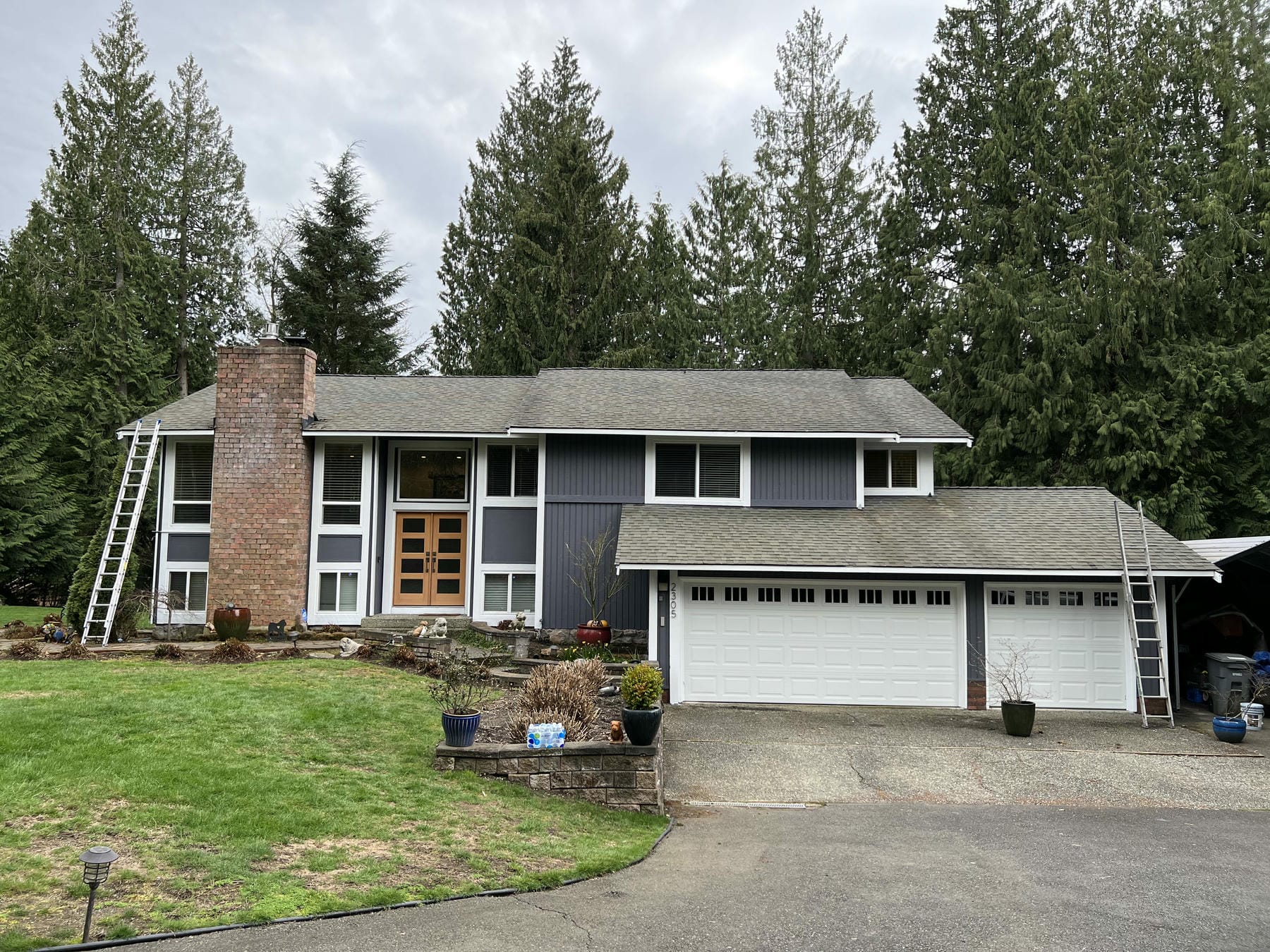
If you’ve watched a fresh coat of paint stay tacky for days on a cloudy Everett, Marysville, or Bellevue afternoon, you already know that exterior paint drying time works differently here than it does in drier parts of the country. Snohomish County’s marine air, frequent drizzle, and cool mornings all slow the transformation from wet paint to a fully cured, weather-ready finish. This guide breaks down the science behind paint drying time in our region, what the local climate data actually shows, and how Legacy Painting times every exterior project to protect your home.
Why Paint Drying Time Works Differently in the Pacific Northwest
Wet paint isn’t finished the moment it looks dry to the touch. Acrylic latex, the coating used on most modern siding and trim, starts as tiny polymer spheres suspended in water. As the water evaporates, those spheres press together and fuse into a single, continuous film in a process called coalescence. Oil and alkyd paints cure differently: their solvents evaporate quickly, but the resin itself has to chemically react with oxygen in the air, a much slower process that can take 12 to 24 hours before the film can handle even light rain.
Both processes depend on the same three variables: temperature, humidity, and airflow. In a dry, sunny climate those variables cooperate most of the year. In Snohomish County, they frequently don’t, which is exactly why exterior paint drying time is such a common question for local homeowners.
Our Rain and Humidity Patterns, By the Numbers
Snohomish County shares the same maritime weather pattern as Seattle: frequent, low-intensity rain rather than short, heavy downpours. Measurable precipitation falls on roughly 150 to 160 days a year here, which means uninterrupted drying windows are genuinely scarce outside of summer. The table below shows average monthly rainfall for the Puget Sound region, based on NOAA climate normals, and illustrates just how tight the historical painting season has been.
| Month | Average Rainfall (inches) |
|---|---|
| January | 5.78 |
| February | 3.76 |
| March | 3.94 |
| April | 3.06 |
| May | 2.10 |
| June | 1.49 |
| July | 0.70 |
| August | 0.88 |
| September | 1.50 |
| October | 3.24 |
| November | 6.57 |
| December | 6.07 |
Humidity, Dew Point, and the 5-Degree Rule
Rainfall totals only tell part of the story. Relative humidity swings dramatically over the course of a single day here, often peaking near 85 to 87 percent before dawn and dropping to 47 to 62 percent by mid-afternoon. That swing matters because a coating can only dry as fast as the surrounding air lets it: warm, drier afternoon air pulls moisture out of a fresh coat, while cool, saturated morning air traps it in.
The single most important number for any painting crew is the dew point, the temperature at which air becomes fully saturated and moisture condenses on surfaces. Industry best practice requires the substrate and air temperature to stay at least 5 degrees Fahrenheit above the dew point, and rising, before and during application. Get too close to that line and invisible condensation can form on the siding, ruining adhesion before the paint ever has a chance to cure.
To take the guesswork out of it, professional crews track a short list of benchmarks before rolling a single wall. Here’s the cheat sheet Legacy Painting uses on every Snohomish County exterior job:
| Condition | Minimum to Apply | Ideal Target |
|---|---|---|
| Surface Temperature | 35°F (modern coatings) | 55°F to 88°F |
| Relative Humidity | 40% or lower | 50% to 60% |
| Dew Point Margin | 5°F above, rising | 10°F above, rising |
| Dry Weather Before Painting | 24 hours | 48 hours |
| Dry Weather After Painting | 48 hours | 72 hours |
Why Paint Chemistry Matters as Much as the Weather
Not all exterior paints handle our climate the same way. Traditional oil and alkyd paints rely on a slow chemical reaction with oxygen to cure, which typically takes 12 to 24 hours before the film can tolerate even light rain, and they demand a bone-dry substrate to begin with. Standard acrylic latex dries faster but has its own limit, a Minimum Film Formation Temperature, usually in the 50 to 90°F range, below which the paint’s polymer particles simply won’t fuse into a solid film.
That’s where next-generation exterior coatings have changed the equation. Formulations such as Sherwin-Williams Latitude and Benjamin Moore Element Guard were engineered specifically for cool, damp climates like ours. Both can be applied at surface temperatures as low as 35°F and develop rain resistance in as little as 30 to 60 minutes, a fraction of the time older coatings required. That kind of performance is what allows a well-equipped crew to keep working safely through shoulder-season conditions that would have shut down a project a decade ago.
Don’t Skip the Moisture Check on Your Siding
Air temperature and humidity are only half of the equation. Most homes in Snohomish County are sided in wood, cedar, pine, or fir, which constantly absorbs and releases moisture from the surrounding environment. Painting over wood that’s too wet is one of the most common causes of early paint failure, and it can cut a coating’s expected lifespan from a decade down to a single year.
As a rule of thumb, wood should test at 15 percent moisture content or lower before priming or painting. Professional crews confirm this with pinless electromagnetic moisture meters, which scan large sections of siding quickly without damaging the surface, then follow up with a pin-type meter to verify any suspicious readings. If the substrate comes in above that threshold, the only fix is patience: let it dry out before touching it with a brush or sprayer.
The Best Time of Day (and Year) to Paint in Snohomish County
For decades, the local painting season was squeezed into a six-to-eight-week window in July and August. Modern coatings have stretched that calendar considerably, but timing within each day still matters. Experienced crews use a strategy sometimes called “chasing the sun,” working east-facing walls in the morning as the sun burns off overnight dew, moving to north-facing walls at midday, and finishing on west-facing walls in the afternoon when they receive the most direct heat. South-facing walls, which stay warm most of the day, are often saved for the times when a slower, more even dry is preferable and flash-drying needs to be avoided.
Wind matters too. A light breeze can meaningfully speed up drying by carrying humid air away from a fresh coat, but crews still need a stretch of at least 24 hours without rain before starting and 48 hours afterward to let the film fully set, longer for oil-based products or if a heavier shower rolls through.
The Legacy Painting Approach
Every exterior project we schedule in Snohomish County is planned around these same variables. Our crews check dew point margins and surface temperature before the first coat goes on, verify moisture content on wood siding and trim with professional meters, and choose coatings suited to the specific conditions of your home’s site, whether that’s a shaded, moisture-prone north wall in Everett or a sun-exposed stretch of siding in Marysville. That approach is how we deliver a finish that holds up to our climate instead of fighting it, even outside the traditional summer window.
If you’re planning an exterior painting project and want it done right the first time, reach out to Legacy Painting for a free estimate. We’ll walk your property, talk through timing, and help you choose a coating built for Pacific Northwest weather.